fredag 16. mars 2018

Åleine, ja - men einsam?

Då eg var liten gut (og det er lenge sidan, veldig lenge sidan!) kunne det henda at eg gjekk og tenkte at eg var einsam. 

Men var eg eit einsamt barn? 

Kanskje eg berre kjeda meg? 

I lange periodar av tenåringsalderen hadde eg ein god kamerat, ein som eg i mange år møtte kvar dag etter skulen og brukta tida mi saman med, ein som eg fekk reisa på tur til hytta med, saman med foreldra hans. 

Det var nok slik at det fanst tider i oppveksten då eg var åleine og då eg gjekk og kjeda meg. Men var eg derfor einsam? 

Det eine treng ikkje nødvendigvis inkludera det andre. Eg kan godt vera åleine og kjeda meg. Ja, kanskje er det lettare å kjeda seg når ein er åleine enn når ein ikkje er det? Men samstundes veit eg at å vera åleine for meg i dag - som vaksen - er viktig for at eg skal få gjort det eg helst av alt vil gjera: å tenka, å læra og å skriva.

Eg ser at det som barn var bra for meg å ha ein kamerat, ein å vera i lag med i det daglege. Eg, liksom alle skuleungane, møtte jo andre barn og unge når eg var på skulen, og når eg i tillegg hadde ein som eg kunne vera i lag med på fritida, fekk eg nok det eg som barn hadde behov for av sosialt samkvem. At kameraten min og eg kanskje kjeda oss ein del der vi gjekk gatelangs i byen der eg voks opp, det er jo ein anna sak. Vi kjeda oss saman.

Eit sentralt spørsmål for meg er dette: Er det uheldig eller gunstig å vera åleine og å kjeda seg?

Som godt vaksen har eg ikkje behov for heile tida å vera i lag med andre, og å oppleva ting og dela tankar og erfaringar med dei. Samver med andre er viktig og bra for meg, det veit eg. Men samstundes veit eg at eg har behov for åleinetid, og å ha slik tid trur eg er bra for alle.

Kanskje er det slik at ein som barn og ungdom lettare kjedar seg når ein er åleine, og at dette fort kan bli opplevd som einsemd? 

Eg skal ikkje forenkla dette, og eg skal for all del ikkje undervurdera det at menneske kan kjenna seg einsame og at enkelte er veldig, veldig einsame. Påstanden min er at einsemd og det å vera åleine er to ulike tilstandar. Eg kan godt vera åleine og likevel ha det bra. Men igjen, berre så det er sagt - å vera einsam, å kjenna at ingen ser meg, at ingen bryr seg om meg - det trur eg er svært uheldig. Eg veit at menneske lever veldig einsame i samfunnet vårt, somme lever og døyr i stor einsemd.

*

I den tida vi lever i er det mykje støy rundt oss. Både visuell støy og masse lyd. Og vi lever alle i denne tida. Vi går alle ei viss tid på jorda og under opphaldet vårt her har vi ein del alternativ som vi kan velja mellom. 

Eg kjenner av og til i det daglege at kan det verka som om eg har eit hav av tid å ta av. Men samstundes så veit eg at tida mi er avgrensa, og at totalsummen av tida mi er ukjend. 

Mens eg var i full jobb (undervisning, og seinare vaksenopplæring i vidaregåande skule) tenkte eg nok ikkje så mykje på det. Eg hadde nok med å vera fullt og heilt til stades der eg skulle vera, i jobben, og i familien.

No har eg vore ute av den konteksten i nokre år, har prøvd det nye tilværet, har fått prøva dette å ha mykje tid for meg sjølv, åleine. Tid til å slappa av, tid til å tenka, lesa, læra, planlegga, reflektera.

Eg har nokre tankar som eg trur kan vera gode for dei som er lenger nede på livsstigen. Det er i grunnen nokså banalt, men likevel kanskje ikkje heilt i tråd med slik mange av oss har levd og lever:
  • Nyt tida og det du opplever der du er. 
  • Gå for fullt inn i oppgåvene, ta fatt i det som blir venta av deg, men sei stopp når nok er nok.
  • Ta vare på helsa, slutt med uvanar som røyking, rusmisbruk og for mykje alkohol. 
  • Kom i gang med trening fleire gonger i veka, ta vare på kropp og sinn.
  • Bry deg om dei nærmaste rundt deg, samfunnet du lever i, og verda.
  • Bruk tid på deg sjølv, på å tenka rundt livet, der du er og der du skal.

Ha ein nydeleg dag! :)

torsdag 15. mars 2018

Denne overgangen - hav av tid

Den første tida etter at eg hadde slutta i jobb var litt som i ei tåke. Eg hadde naturlegvis sett det koma, men eg kan ikkje seia at eg hadde laga meg ein strategi for korleis eg skulle handtera det. 

Dei første vekene etter at eg var blitt pensjonist opplevde eg på ein måte som litt flytande. Sjølve dette ordet - pensjonist - var eit ord som eg inni meg, i det ubevisste, skauv unna. Og dette var nok eit symptom, ein indikator på at ikkje alt var heilt på stell i meg.

Dei første vekene etter at eg slutta i jobb sov gjerne eg utover formiddagen. Det var liksom eit fjell av søvn som eg hadde behov for å klatra og ta kontroll over. Innimellom tenkte eg på det. Dette som skulle vera livet mitt heretter, utan jobb å gå til, og all tida eg skulle få disponera sjølv! Kva skulle eg fylla denne tida, dette ubestemmelege tomrommet med?

Det var i grunnen ingen stor dramatikk knytt til dette. Ingen ting var uføresett, ingen ting kom eigentleg uventa på meg. Eg kunne unna meg den sjeldne luksusen å ta det heilt med ro, å berre la tida flyta og å la sinnet og kroppen flyta i tida, akkurat slik det passte meg.

Om morgonen kunne eg vakna, kanskje høyrde eg at dei andre stod opp og gjorde seg klar til å møta den nye dagen, på jobb eller skule.

Eg kunne bli liggande i senga, sova vidare der, la meg gli inn i den milde og lune morgonsøvnen. Eg kunne ta ei bok frå nattbordet og lesa vidare frå kvelden før. Eller eg kunne ta fram telefonen eller datamaskinen og sjekka nyheiter og e-post.  

Det var ingen brå overgang. Faktisk var det ein langsam prosess, denne overgangen til eit tilvære i nye tidsrammer.

Eg kunne stå opp, ta på meg treningsklede og gå eller springa ein tur. Eller eg kunne ta sykkelen og sykla utover mot Hordvikneset og over brua. Eg kunne ta bilen og køyra ein stad, finna på noko banalt eller noko heilt nytt. Som å gå turar i byfjella med likesinna i regi av Bergen Turlag, som å køyra til kjøpesenteret og trilla ei handlevogn formålslaust mellom reolane inne i det store supermarkedet, og til slutt gå ut gjennom kassen til bilen med handleposar tunge av drikke og matvarer.

Det tok litt tid å venna seg til dette nye. Om morgonen og formiddagen var det berre eg i huset. I mange timar var huset tomt for alle dei som vanlegvis skaper liv der, med unntak av meg, som lenger ikkje hadde noko fast på gå til, jobb eller skule. 

Eg skal innrømma at det vart ein del timar som kan sjå ut som bortkasta. Eg kunne vandra frå rom til rom, eg såg ut over fjorden, såg det gråe skylaget over landet lenger nord, eg såg at det var kome litt snø på fjelltoppane. Eg sette meg på kjøkenet, laga meg kaffi, litt formiddagsmat. Ja, eg innrømmer det, eg var på kanten til å kjeda meg, eg mangla meiningsfylte alternativ til det å skrolla ned og opp på nettsider etter dei siste nyheitene. 

Det tok litt tid før eg såg det klart. Eg var komen til eit stadium, på ein stad i livet der rammevilkåra var vesentleg endra, og der kanskje den største og mest merkbare endringa var tida. 

Og eg gjorde ei interessant oppdaging. Eg merka at tida var der for meg, at det ikkje hasta slik som før med alt. Eg vart klar over at eg hadde hav av tid framfor meg og rundt meg. Eg var faktisk komen til eit punkt i livet eller ein tilstand i tilværet der eg rett og slett var priviligert!


Ha ein fin dag! :) Og del gjerne!

onsdag 14. mars 2018

Ein annan puls i livet


Nesten heile livet har eg brukt tida mi på arbeid, meir eller mindre systematisk og målretta. Først bortimot 20 års utdanning (skulegang og studiar for å kvalifisera meg for arbeidslivet), og deretter i betalt arbeid i om lag 40 år, frå 1974 til 2014.
Å vera i full jobb betydde for meg liksom for alle andre at eg mot pengar har gitt bort ein stor del av tida mi for å utføra arbeidet for arbeidsgjevaren, som då har «eigd» meg i denne tida. I mitt tilfelle var arbeidet undervisning, dei fleste åra som lektor i skuleverket, 7,5 timar kvar dag, fem dagar i veka.

Og så skjedde dette for litt over tre år sidan - eg slutta i jobb. Eg kan ikkje seia at det kom uventa, det var heller planlagt, og venta. Så å seia over natta endra rammene i livet mitt seg vesentleg. Eg fekk plutseleg begynna å bestemma over tida mi sjølv. All tida, alle dagar, alle timane i døgnet kunne eg med eitt disponera sjølv, eg kunne bruka tida mi til dei private og familiære formåla eg sjølv prioriterer.

Denne nye, uvante fridommen! - Denne svære forandringa! 

Eg har fått det litt på avstand no, men i førstninga trur eg at eg var litt nummen, litt slått ut. - Kva skulle eg gjera med all denne tida, med denne nyvunne fridommen?

Det tok litt tid for meg å veksa inn i dette nye. Tok litt tid å finna ut av det. - Var livet på det nærmaste slutt no? Ferdig i arbeidslivet, ferdig med så mangt i livet?

Den første tida var litt uvant. Dagar som var ustrukturerte, der eg var  på leiting etter kva eg ville med desse dagane, all denne tida som eg plutseleg  hadde fått rett opp i fanget.

Eg tok det ganske piano, litt bakoverlent, vil eg seia. Meir om dette i neste post, og i dei som kjem etter den. 


Ha ein fin dag! :) 

tirsdag 13. mars 2018


Alle blir eldre-bloggen, 13. mars 2018

Då eg passerte 67
Skjedde det noko i livet mitt då eg passerte 67? Eg meiner - heilt sånn grunnleggande? 
- Var det ein overgang til noko heilt nytt og annleis i livet mitt? 
- Eller var det slik at livet berre heldt fram, litt endra, men det same livet, stort sett i dei same spora? 
Eg har tenkt at eg i dei komande episodane i alleblireldre-bloggen skal skriva litt rundt dette og relaterte tema. Og når eg skriv det slik eg gjer her og no, så er eg vel vitande om at eg lover noko, eg forpliktar meg, eg seier at eg skal følgja det opp, det skal koma meir. Og det har eg tenkt å stå ved. Så får vi sjå korleis det blir.
Ein del av dei som les eller kan lesa dette, er meir eller mindre på min alder og har dermed parallelle erfaringar og opplevingar i forhold til det eg kjem til å skriva om. For andre lesarar av alleblireldre-bloggen er alderen min eit tal veldig langt unna, og dette talet kan kanskje for nokon verka framandt eller litt urovekkande høgt.
Eg kjem til å skriva med begge desse hovudgruppene lesarar i tankane. 
På den eine sida kan vi gjerne seia at alder berre er eit tal. Vi er alle menneske, vi lever i det same landet, og vi sit på ein måte alle i den same båten, når alt kjem til alt. 
På den andre sida er det jo sjølvsagt slik at godt vaksne menneske kan ha ting å formidla til yngre - innsikter, tankar og fakta som yngre lesarar faktisk kan ha nytte og glede av.
Eg har lyst til å skriva om alt: Om det som var, og om det som ikkje var, men kunne ha blitt. Og eg vil skriva om det som er her og no, der vi alle er: i livet, her i dette landet, i verda, i dette året 2018.
Som eit mål for dette prosjektet vil eg setja opp at bloggen - som alltid skal innehalda både tekst og bilde - skal beskriva viktige sider ved den tida og det samfunnet vi lever i, og bloggen skal beskriva verda rundt oss og inni oss slik dette blir opplevd gjennom eit sinn og sansane til ein som har levd her i sju ti-år. Bloggen skal streva mot å gi eit sannferdig og engasjerande bilde av tida, landet og menneska som rører seg i landskapa.

Kom gjerne med spørsmål, kommentarar, innlegg! 
- Og del gjerne med andre!

På grunn av tekniske problem flyttar alleblireldre-bloggen hit, til https://lifeinthe20thcentury.blogspot.no

Øivind


lørdag 21. oktober 2017

På veg oppover

Eg står ved snøkanten bortanfor parkeringsplassen og tar på meg utstyret. Nykjøpte randonneeski med høgteknologiske bindingar, sko og stavar, til ein pris eg verken vil snakka om eller tenka på. Eg rettar blikket og tankane framover, oppover, mot toppane bak den snødekte slalombakken som er forlatt for sesongen og ein ypparleg plass å starta for ein som vil gå til fjells mens det enno er snø der oppe.

På veg oppover i fjellsida tenker eg på Sisyfos. Sisyfos er ein figur i gresk mytologi, konge i Korint, som i følgje segna til evig tid var dømd av gudane til å trilla ein stor stein oppover ei bratt fjellside. Kvar gong Sisyfos nådde toppen med den runde steinen, rulla steinen ned igjen. Blant dei som har interessert seg for denne figuren og lagnaden hans, er den franske forfattaren og filosofen Albert Camus. Camus publiserte i 1942 essayet «Le Mythe de Sisyphe» - Myten om Sisyfos. I dette essayet introduserer Camus filosofien sin om det absurde: menneske opplever verda som meiningslaus og uforståeleg, gud er død og det finst ikkje evige sanningar eller verdiar. Vil ei realisering av det absurde kreva at ein tar livet av seg? Camus svarer: "Nei, det krev opprør.» (Kjelde: Wikipedia).

I essayet Myten om Sisyfos skriv Camus ein stad om Sisyfos, antihelten sin, i den fasen av det harde arbeidet han er pålagd då han er på veg nedover igjen, etter at steinen har rulla ned: «Il faut imaginer Sisyphe heureux.» - Ein må tenka seg at Sisyfos er lykkeleg.


Eg tolkar Camus slik at Sisyfos, når han er på veg nedover igjen etter den store innsatsen og anstrenginga, finn tid og rom
for refleksjon, for å kjenna etter og setja ord på det han  kjenner på og går gjennom. Han er tross alt i live, og han har endå ein gong klart å utføra den tunge og vanskelege oppgåva han er pålagd.

Eg kjenner meg delvis igjen i Camus si tolking av lagnaden til Sisyfos. Vi menneske som lever i dag kan langt på veg - med all informasjonsflyten og all kunnskapen som flyt forbi oss, oppleva verda som litt meiningslaus og langt på veg uforståeleg - gud er død og det finst kanskje ikkje så mange evige sanningar eller verdiar. Det siste er det jo opp til oss som lever saman i verda i dag å setja ord på og å bestemma. 

Eg følgjer Camus si beskriving av lagnaden til Sisyfos, men eg opplever ikkje Sisyfos nøyaktig på same måte som Camus. Det er når eg sakte og møysommeleg trakkar oppover fjellsida i fjellsko eller på randonneeski med fellar, og utan den tunge børa som det er å trilla ein rund stein oppover - at eg kjenner på slektskapen min med Sisyfos. Dette - når eg sakte og roleg trakkar oppover utan å slita meg heilt ut - er den privigilerte stunda mi for å kjenna etter, for å la tankane flyga høgt og la kjenslene sveva i det uendelege rommet over meg. Det er på vegen oppover i fjellsida at eg kjenner på noko som eg vil kalla lykke, om enn ein veldig beskjeden variant av det slaget.

mandag 15. desember 2014

Tren deg glad :-)


Snart er det eitt år sidan eg begynte eit litt nytt liv med meir fysisk trening enn det eg tidlegare har gidda. Det starta med at eg kjøpte medlemskap på eit treningssenter der eg trener (løp og styrke) mens guten vår er på svømming. Sidan starten i januar har det blitt mange treningsøkter - på Actic, sykkelturar til Flatøy, innefotball kvar veke med gutane (lærarkollegaer) på Knarvik vgs, springing/jogging i nærområdet og i Oppdal, sveitte turar oppover fjellsidene både her vest og i Oppdal og alle dei skiturar eg har klart å få til (veldig dumt med slike snøfattige vintrar som vi har hatt!). Eg elskar slike treningsøkter som gjer meg sveitt og andpusten. Trening tar jo tid, og eg skal ikkje underslå at overgangen  frå å vera i jobb  til sjølstendig næringsdrivande har gitt meg veldig god styring og kontroll med tida mi :-). Det er berre herleg å kunna dra på seg treningstøy og legga ut på ein sveitt tur, og kjenna dei gode endorfinane som løftar sjela og gir meg den særeigne lykkjekjensla. Saman med alle dei andre gledene i livet så er dette for meg oppskrifta på det gode livet. 

Med dette utfordrar eg alle slektningar, venner og kjenningar til å ta opp hansken: Kom i gang og tren deg glad! Som motiverande lesing kan eg anbefala Cardiac Exercise Research Group (CERG) sine nettsider (NTNU, Trondheim): «K.G. Jebsen - Senter for hjertetrening. - Vi studerer effekten av trening som medisin for å behandle hjerte- og livsstilsrelaterte sykdommer, og har som mål å finne optimale treningsprogram slik at vanlige mennesker får og bevarer en god helse gjennom hele livet.» http://www.ntnu.no/cerg

lørdag 16. august 2014


A demonstration day in Patras - and my kind of greek odyssee

image
Wednesday morning I had the chance to be picked up at the hotel by one of the volunteers from Sandy’s institute. She took me in her car to the Archeological museum of Patras, and I enjoyed going there between the showcases and look and learn about the many thousand issues from old times, found in the ground in the region of Patras, that are exposed there. - The city of Patras has a really beautiful and quite new archeological museum.
image
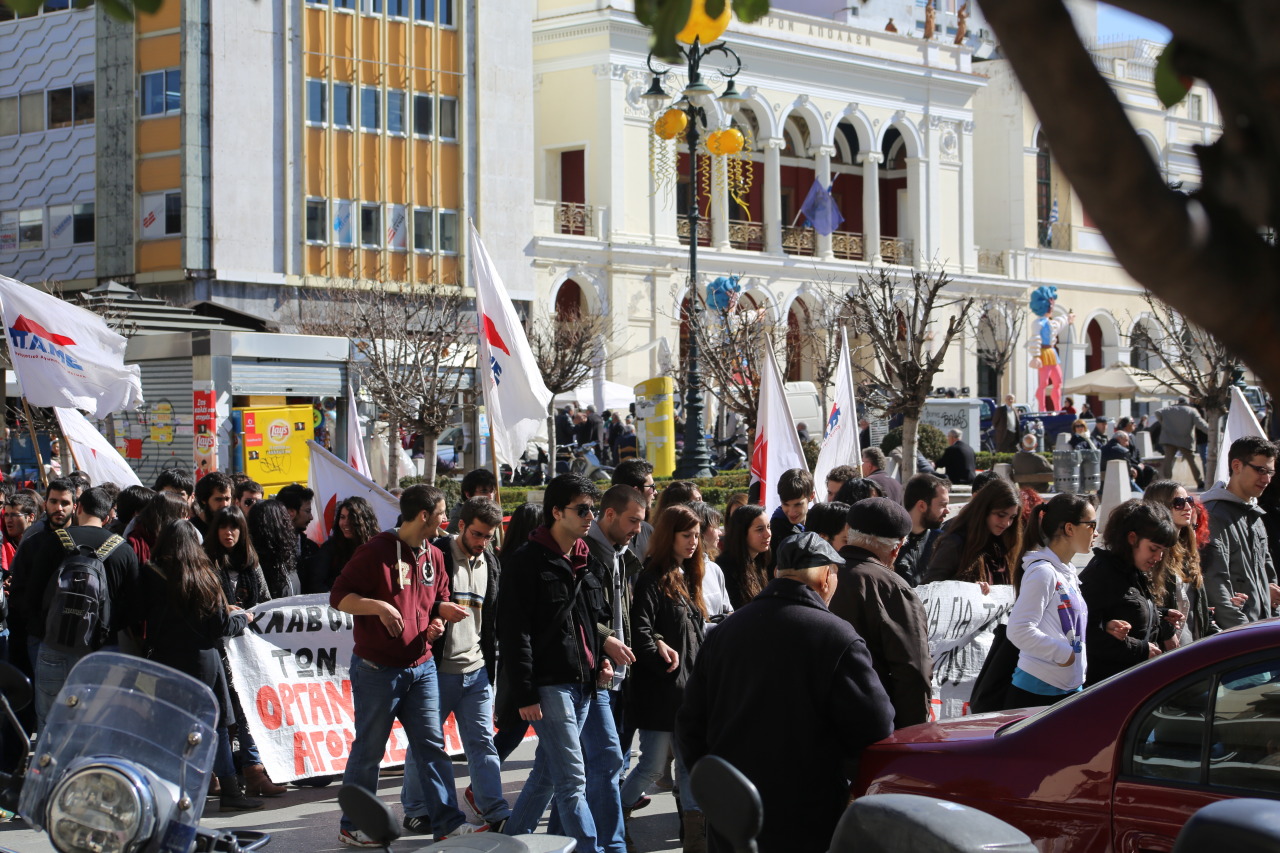
After the visit to the archeological museum I went for a walk in the streets, and I came across a demonstration that took place that day in Patras. In the demonstration I noticed there were flags and slogans of different colors, the red flags of the communists, white slogans and black slogans (the anarchists). A young woman who was apparently supervising the demonstration with the group of black clothed young people - some of them had covered their face - told me not to take photos, probably (or maybe) out of fear of being registered by police!
image
In the afternoon Katerina, one other of the volunteers from Sandy’s organisation came to the hotel and took me for a walk in the town. We walked through the streets of the old town and she took me to a bar where a group of her friends sat talking, eating, drinking, smoking and laughing.
I was welcomed from them all, it was really a good ambiance there amongst these young people and I felt well in their company. I asked some questions about how they felt about the actual situation in their country. They did not feel good about it of course, but what can one do in a situation like this where almost everybody has to accept a reduction of income of up to 40%?
image
What they said and what I saw is thay they try to keep each other up, and they try to do things as usual and make what they can to live a normal life. Some said that in times like these of crisis it is more frequent that people stick together and that they help each other. In times of crisis the positive values of friendship and helpfulness are more common. On the other side, in countries where the crisis is not felt so hard, it is more common to see people who do not seem to care, for instance the huge drops-out rates from school in Norway, a country  where wealth seems to be the privilege of almost everybody.
image
In addition to my questions about the effects of the crisis to the young people, I asked the same questions to some Greek colleagues whose answers mainly confirmed what the young ones had said: Many people have lost a big part of their income, pension, etc. The economic crisis is here due to the bad decisions of the politicians and the banking system. People in Greece have felt very unhappy and stressed during the last three years. A few people have committed suicide and many people have psychological problems because they don’t know what will happen tomorrow. Everybody is upset about this situation.
image
I also asked how they think they will manage to handle  this situation during the next years. The majority of the Greek people have the opinion that the «receipt» given to Greece by the European Union and the IMF is wrong. In Greece now they have the opposite results, as the deficit is increasing instead of decreasing. One way to handle this crisis is to stop this «momorandum», i e not to follow this «momorandum». Nobody knows when and where these very strict measures will finish.
image
In the evening we (the two Norwegians, the only Storysavers guests who had arrived that day) were picked up by Sandy and dropped into a art gallery where there was the opening (French: arrosage) of Kara Vasilis’ painting exhbition. We were very happy to be there before going to have dinner with our host and her colleague in a good Patras restaurant.
I also experienced the famous Greek hospitality on Thursday when we (two Norwegian visitors) were invited to se the Folklorique museum of Patras, and afterwards were invited to a delicious luch in the home of the responsible of the Museum. We hade a few fine hours of friendly talk and relaxation. The same couple who received us for lunch on Thursday on Friday very kindly put me and my luggage together with them in their private car and started to drive me towards Athens, after we had waited one hour for the bus to come. We had bad luck and ended up in a blocked mainrod beacuse of the local population of Egio’s demonstration against the treath of moving a university faculty away from Egio.
image
One can of course understand their fear and anger of loosing their faculty, but that had the effect on my journey that I was in danger of not getting to Athens airport before my flight was to leave. The final solution was a taxi and a young taxi driver who drove me 200 klílometers in two hours and made it possible for me to drop my luggage at the air company’s counter just in time!
Wednesday 20 February 2013 - first day in Patras. A lot of things to see! First I was accompanied on a visit to the Archeological Museum of Patras… 

søndag 4. mai 2014


The storyteller’s story

There is a man sitting in a house in Odda, in a room overlooking the bay, a man who tells stories from large and small events in Odda. He has named his blog «Oddajangen» and he has had a long working life as a journalist and writer. In 2007, he was hit by a powerful brain stroke, and after an initial recovery period, he was for a while dependent on a wheelchair to come out and around in the local community. 

Jangen is the type of man who does not give himself over. He struggled up from the wheelchair and can now walk again. Jangen has in recent years started an impressive storytelling project with his blog, where he publishes almost daily ever new stories about people who have lived or are living in the community of Odda. He has these years published more than 800 stories in his blog, and this year he released a selection of his internet stories in paper book format, to the delight of the many who are not on the internet. Here is Jangen's story with his own words:

pastedGraphic.pdf

«Close to Oddajangen» (2011)

The years go fast. It's been nine years since I quit Haugesund Avis (The Haugesund Journal). The very best working years I have had. I started in 1970 and worked with Haugesund Avis until 2004 .

Now it's different. Retirement age became busy enough. Book about Tyssefaldene, a giant bang (cerebral hemorrhage) in 2007, one year of rehabilitation (an amazing rehab in Odda). Participated in a book in 2009, wrote "The Other Harding " which came out last fall and writing - mostly - daily for my blog. "Oddajangen."

Became grandfather for the seventh time and great-grandfather for the first and second time in 2010 and in 2012. The cerebral hemorrhage was important and was not possible to operate. I was driving around with the electric chair at 9.9 kilometers per hour, but walking more and more. Speaking roughly clean. On Friday nights I lie down in my special bed, have a glass of red wine, ok two, watching the Golden Numbers (Lotto) on the national tv channel, NRK, watching Thomas and Harald on TV2 and ....... snoring , snoring. I'm afraid the rest disappears into the dark of night.

I started the blog to tell and at the same time preserve the stories from our little part of the world. But it has become more and more local politics. I have since 1970 followed Odda politics, I think I have some idea what 's going on. What has happened in recent years - behind the scenes - is not particularly beautiful. If everything came up in the light, there is much evidence to suggest that some political careers would get in serious trouble.

Some probably think that I'm a little too direct, but it's my way of saying things. Moreover, I believe that politicians should accept critical eyes. There should always be a critical focus on the politics conducted.


pastedGraphic_1.pdf


lørdag 15. mars 2014

Excerpts from The White Coals by Gro Holm. Gyldendal 1936


1936 novelist Gro Holm published the novel The White Coals, which describes how some smart merchants robbed the local landowners in Odda. Gro Holm gives a harsh depiction of how the acquisition of waterfalls could take place, how farmers allowed themselves to cheat to sell waterfalls for next to nothing. Solicitor Våtemyrs acquisition of Skjeggedal waterfall might seem like a caricature, but it is true. A journalist who questioned the sales price of one hundred crowns, was told by the author that she had set up the sum to be believed. 


Andersen: "There seems to be competition for the waterfalls. One waterfall after another is sold. I do not understand what will happen, there will be a setback, there is no need for all these waterfalls. At least not for a long time yet. It's as if people do not see the difference between good and bad waterfalls. When only it’s named waterfall. But this looks good. We'll ask Hjort, and hear what he believes and if he thinks it's good we will write to Paris and ask what they will give."
Dahl took the letter up and looked at it. 
"Two hundred thousand. Yes that might be. The construction of facilities would cost millions. We shall write to Hegrenes and get a printout of the deed. This can become a pretty business. This one speaks against; what speaks for, is the waterfall itself and it’s undeniable advantages. But as you in the price you asked for has gone from 200 000 horsepower, what do you say about an offer from us of 150 000 crowns? It might still be the one crown per horsepower."
"No, there can be no question of that," replied Våtemyr quickly. "I was not determining the price by a crown per horsepower. And that is 200 000 crowns for such waterways? The development will the nevertheless cost millions. It cannot at all be calculated on millions exactitude."
"Excuse me, is it not the case that the sollicitor has given the seller one hundred crowns for the property?"
It was quiet around the table. Where the heck would he go now, Rolf thought and began to draw figures in the margin of the calculations.
"Yes, that is correct, the previous owner has even received it as a gift."
"Gift?"
"Yes, gift." Våtemyr was visibly pleased, he will not get me angry, if that's what he wants. "But I do not understand what this has to do with the business. My title to the property is in good order."
"We who are informed, know that there is no need for all this hydroelectric power that is now on the market. There is only need for a small part, the very best."

Våtemyr and Seljevik said goodbye and when they were gone Dahl said: 
"You can never restrain yourself! What would be good to mention the hundred crowns? "
"But dear, one must be allowed to amuse oneself a little now and again. Good for him, the damn fool. Sitting and keeping the secret for 3 years until the inheritance deadline had expired, and come with their offer the same day he was safe! Yes, I have seen on the registration date. What a vile guy! Gift! Did you hear that? Yes, I said gift. Not because I believe that the farmer shall have one hundred and fifty thousand of the falls. He's probably happier without, but something shall have."

...

Samuel stood in the woodshed when his brother came. He was surprised by Anders who looked so out of breath. He stood with the piece of wood in hand and wondered what could now be wrong. Something was wrong.
"When did you sell the waterfall," Anders blurted out without introduction.
"Sell? I have not sold anyone waterfall."
"You have sold, how have you sold ? You have sold Long Valley and the falls."
Samuel put away his wood . "Oh, Long Valley," he said. "Yes, Våtemyr, the solicitor, would be able to buy fishing rights in Long Valley. He and certain other fellows would give the right to the Crown Prince, you know . "
"And how it went? He bought it then?"
"Yes , he did."
"Do you have the papers?"
"No, I do not have the papers."
"But what was in the paper, I suppose he read something for you before you signed."
"Yes, he read it."
"But what was it then?"
"No, I do not remember now, it's so long ago. He did not care about it, because I have not seen him later."
"What did you get then?"
"To have a man like that visiting us you know it was an honor to have him here . I got a hundred Crowns. "
Anders trembled where he stood. "And Våtemyr has sold . He has received 150 000 for the valley and the falls," he screamed.
"No, he has?" Samuel said quietly and took up the wood and lifted the ax. "So he might come then, the Crown Prince?"

...

Up on Rokkejuv Samuel went in the same days and was moping around more than usual. He had probably been too sloppy with Long Valley. If not Anders would not have been so angry. There had to be something he did not understand. Waterfall? Yes, tourists came and looked at the waterfall. The waterfall was magnificent, it was impressive, one might be purely dizzy when standing up there staring down at it, and both he and Anders had a small profit by it. But he had never heard of a waterfall that could be sold or used for something, it might then be to drive a mill shell or a saw. But then it should not embarrass Anders.
"Is there somehing that bothers you," Sigrid asked, "you go here so dismal."
"Oh not at all," he replied.

...

Lisa sat down . "It cannot be true," she said. "They must be wrong."
"No, unfortunately, we are not wrong. You've talked with Hansen?"
"Hansen yes, he said he only would chart the landscape. I thought it was the state that would have maps of the mountain. But what do they want with it, what will they use it for?"
"Ay, they will build factories and power stations. Electric power they say. It's so new, that we in here do not know what electric power anyway. And what they are to fabricate Hansen will not tell us."
"However, the pasture and farm paddocks! Has Samuel really sold the farm?"
"No, pasture and farm paddocks were excepted, Våtemyr had done it anyway. Anders has got hold of the paper and we have read it many times."
When Lisa heard that the farm was excepted she became relieved and she said: "Thank God" and she said that maybe it was not a big deal anyway, they could then go on living as they had done, for she knew nothing about dams and tunnels and cableways.
"There 's nobody here," said Berta, "who knows how bad this can become, but we have at least read so much newspapers that we know that there will be a change. If this is new, it is although not the first facility in the country."

But he continued in the same manner and for long periods he could be standing and staring straight before him, and then he could start to shake his head and mutter something. "There must be contained somewhat below," he muttered.

fredag 14. mars 2014

Odda and it’s Melting Factory. Part 1 - the roots


Odda and it’s Melting Factory

part 1 - the roots


Photo: N.V.I.M.

I was born and grew up in this small industrial town, Odda, situated in the western parts of Norway at the end of a deep fjord, in a narrow valley under mountains up to 1400 meters high.

When I grew up at Odda, there were approximately 9000 inhabitants. The population rose to 10000 in 1970, but today it is reduced to less than 7000 inhabitants.


Photo: N.V.I.M.
Photo: N.V.I.M.

Around 1900 Odda was an idyllic rural place with only a few hundred inhabitants. At the end of the 19th century Odda had long been a world tourism Mecca. Tourists came to Odda from many European countries to admire the beautiful waterfalls, the mountains and the glaciers around Odda.
Photo: N.V.I.M.

During the summer Odda could be visited by up to 80 tourist ships, and there was a lively trade with all the horse-drawn carriages that in a hurry were transporting tourists from the harbour and up to tourist attractions such as Låtefoss waterfall and back down the Odda valley to the many hotels that existed in Odda at the time.

Among those who came back to Odda year after year was Emperor Wilhelm the second and many other wealthy Europeans, including several English Lords, who loved to fish salmon.

Photo: N.V.I.M.
Hotel Hardanger

Down by the fjord there was a great hotel in the Swiss style, the Hotel Hardanger which was at that time the largest wooden building in Northern Europe. After 1906, with the sudden stop of the tourist industry that occurred after industrialization, the stately wooden building was used for many different purposes, typically as an assembly hall, a library, a cinema and conference, meeting and training facilities for several local teams, the town hall and school. Finally, after many decades of such use, the Hotel Hardanger was demolished in the mid 1970s. The demolition was regarded as a big mistake at the time and is still regarded as a big mistake today.
1906, when industrialization came to Odda, huge changes started to occur. The population increased in a few years from a few hundred to over five thousand and many houses and many different facilities were built. The whole place was transformed in just a few years.

Photo: N.V.I.M.

The first years of the 20th century saw a few visionary young engineers and lawyers with new knowledge and competencies (and with capital) travel in the mountains around Odda, mapping the rivers and waterfalls they saw there. They were aware of the great opportunities of the waterfalls in the region, and they bought the waterfalls rights and land from the peasants for almost nothing. They did so because they had information that the industrialization pioneers were in the process of planning a large-scale industrialization in Odda and Tyssedal. These waterfall rights that the engineers and lawyers had acquired from the landowners for very little money were rapidly sold on to the industrialization pioneers for many times the initial price.


1936 novelist Gro Holm, who herself was married to an engineer who worked on the melting plant in Odda, published the novel The white coals, which describes how some smart merchants robbed the local landowners. - One could compare the rape of Odda to the way the native Americans were tricked out of their land, and also the Zulu in South Africa and the aborigines in Australia, etc.

- One could compare the rape of Odda to the way the native Americans were tricked out of their land, and also the Zulu in South Africa and the aborigines in Australia, etc.


1906 the industrial adventure started in Odda, with the construction of the factories that for almost one century had a very strong impact on the society of Odda. In few years the place grew from a few hundreds of inhabitants to several thousands. Historians relate that there were hundreds of people taking part in the construction of the new society, coming from other parts of Norway and even from abroad, especially from Sweden. The construction workers and their families were during this initial period living in very bad conditions in the centre of the place, and there were battles and disorders every night due to the lots of people stewed together in small places.

"When the factories began operating workers' dwellings were built. The first was built in Nyland and the farm Bokko where the factory had now bought land for construction. There were wooden houses with 4 apartments with one room and a kitchen in each. 1912 the last dwellings at Nyland were finished, and 1913 came the large three-storey Murboligen - the brick dwelling -  at Bakke, facing the 9 small dwellings of wood that already were built on the new empty land just behind the central dwelling area. Centrally between the hand craft environment Brotateigen and the old farmstead in the village was this strange brick coloss, witnessing that a new type of living environment seriously had gained access to the old village community."
Photo: N.V.I.M.

A total of seven barracks came up. They were originally meant to haddock special workers, and they were soon crowded with people. "They were just like the chosen."  One of the barracks was consecrated as the dining hut. Here it was possible to buy dinner for anyone who could not work it out otherwise.

For the villagers the barracks at Nyland were in many ways the symbol of all that dangerous and morally reprehensible that followed the new time: «There was drunkenness and fighting, it occurred every day. It happened we arrived on Monday morning going to school, and we heard screaming, yelling and commotion down there. We did not dare go the road way, so we went up to the chapel and then down to the village.»

"The first factory workers 
The relative prosperity was founded on a steady production increase at the two factories. The Carbide Factory started with a crew of around 500 in the period 1908-1912, 600 to 700 in the period 1912-1920, with a peak of about 950 during the war. The Cyanamid Factory had a similar development: about 400 in the period 1908-1912, about 600 in  the year of 1912, with a peak of about 700 in 1914/18. The workers came literally from all over the country. In addition, there was a strong element of Swedes. The rumor of well-paid work in Odda spread quickly. Often it occurred that workers from a village or a town attracted acquaintances and relatives when they had been home for a visit.
Photo: N.V.I.M.

When I was born, a few years after the end of the second world war, a great period started in the life of my hometown, certainly due to the good historical frame conditions. This was a period of optimismm, a national political consensus and general economic growth. Willy Ingebrigtsen tells of when his father got work at Cyanamid in 1909: 

"Yes, after what mom told, father went to sea, and they only had a small apartment in Bergen. Then they had the two boys, my older brothers. When the father came home from the sea, they read in the newspaper that they needed people here in Odda. And there were rumors that they earned very good money in here. So father traveled in, he wanted to probe the ground. He found work in the workshop. 
Then mother could tell these other women in Bergen that father earned four crowns a day. And then the housewives clapped their hands together; four crowns a day! Have you heard anything like it! They earned only two crowns a day in Bergen then. That was in 1909."

Photo: N.V.I.M.

The history of Odda shows both ups and downs. There was a very optimistic period just after the construction of the factory. But already in the early twenties came the breakdown. The factory was broke, and it lay down for several years until new financing lifted it up again.
Photo: N.V.I.M.

When I was born, a few years after the end of the second world war, a great period started in the life of my hometown, certainly due to the good historical frame conditions. This was a period of optimism, a national political consensus and general economic growth.

This was the period of national reconstruction after the war. For many years the country was governed by the labor party and it’s leader Einar Gerhardsen, the «land father».  Norway’s focus during the fifties and the sixties was on reconstruction, increased material wealth and social inclusion, and little by little the material conditions improved all over the country. In particular in places like Odda the municupality was very wealthy, thanks to the huge income from the leases of the waterfalls, which were signed for quite a long term.


A part 2 is planned to come here:

part 2- Photo gallery, inside Odda's smelter, years 2003 to 2009